
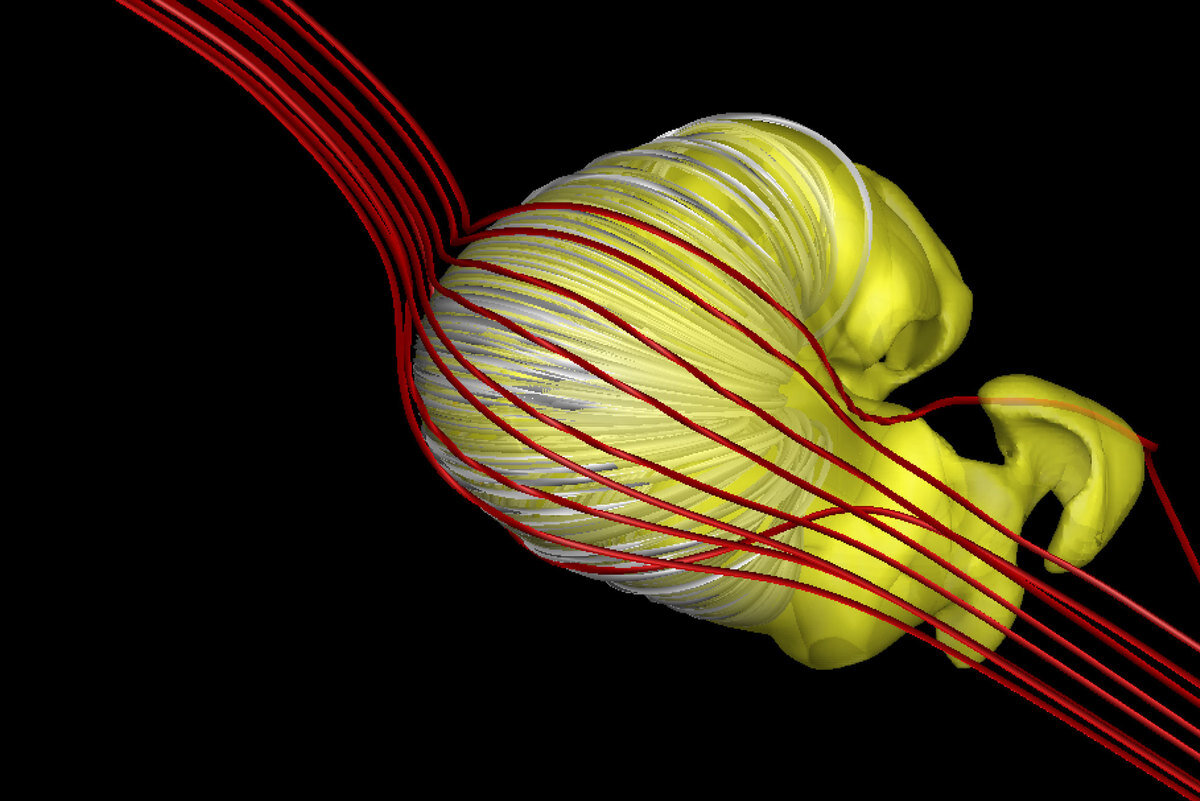
Is this how the heliosphere appears? According to studies conducted by BU, this is the case. Astrophysicists have long questioned the size and nature of the magnetic "force field" that protects our solar system from deadly cosmic rays. Merav Opher et al
A multi-institutional team of astrophysicists led by Boston University astrophysicist Merav Opher has discovered a significant advance in our understanding of the cosmic forces that create the protective bubble that surrounds our solar system, which is known to space experts as the heliosphere.
Astrophysicists think the heliosphere shields our solar system's planets from intense radiation emitted by supernovas, the universe's ultimate explosions of dead stars. They think the heliosphere extends well beyond our solar system, but no one truly understands the structure of the heliosphere—or, for that matter, the extent of it—despite the vast shield it gives Earth's life-forms against cosmic radiation.
"What is the societal significance of this? The sun-created bubble that surrounds us provides protection from galactic cosmic rays, and its form can influence how those rays enter the heliosphere "Opher partners with James Drake, an astrophysicist at the University of Maryland. "There are a number of ideas, but the structure of the heliosphere—does it have creases and folds and things like that—can influence how galactic cosmic rays get in."
Opher's group has created some of the most intriguing computer simulations of the heliosphere, using models based on observable evidence and theoretical astrophysics. Opher, an astronomy professor in the College of Arts and Sciences, directs a NASA DRIVE (Diversity, Realize, Integrate, Venture, Educate) Science Center at BU, which is sponsored by $1.3 million in NASA funding. In an endeavor dubbed SHIELD, that team, made up of specialists recruited from 11 different universities and research organizations, produces predictive models of the heliosphere (Solar-wind with Hydrogen Ion Exchange and Large-scale Dynamics).
Since the NASA DRIVE Science Center at BU was originally funded in 2019, Opher's SHIELD team has been on the lookout for solutions to a number of perplexing questions: What is the heliosphere's general structure? What are the effects of its ionized particles on heliospheric processes? What role does the heliosphere play in the interstellar medium, the matter and radiation that exists between stars, and how does it interact with it? What is the mechanism by which cosmic rays are filtered or transferred via the heliosphere?
"SHIELD builds complete models by combining theory, modeling, and observations," explains Opher. "All of these distinct components work together to help solve the heliosphere's problems."
Now, a report published in the Astrophysical Journal by Opher and associates demonstrates that neutral hydrogen particles coming in from beyond our solar system are most likely vital in the formation of our heliosphere.
Opher's team sought to know why heliospheric jets—blooming columns of energy and matter comparable to other forms of cosmic jets seen across the universe—became unstable in their newest investigation. "What causes stars, black holes, and even our sun to release unstable jets?" Opher explains. "We observe these jets projecting as uneven columns, and [astrophysicists] have been puzzled for years as to why these forms are unstable."
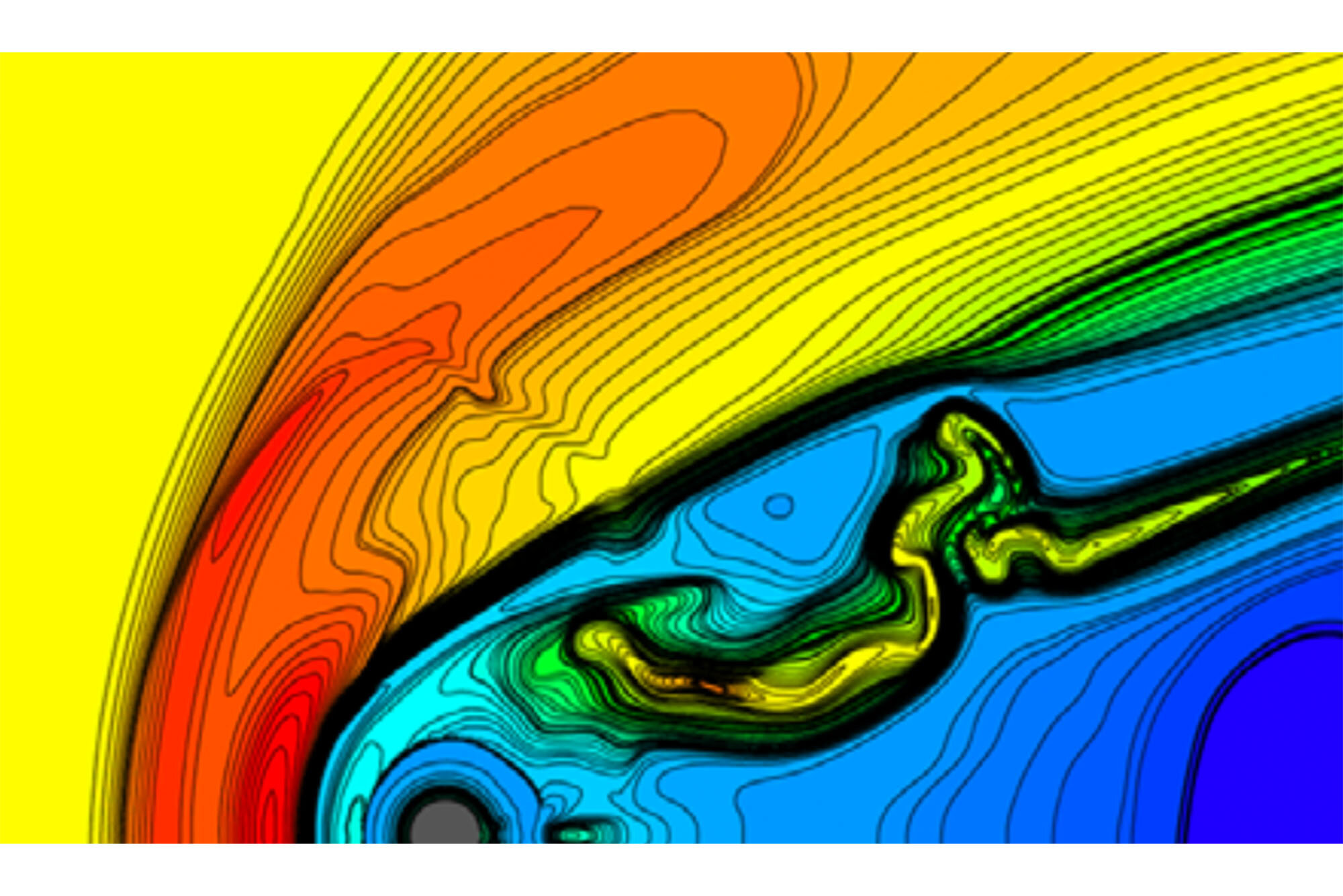
The heliosphere, a protective magnetic "force field" coming from our sun and enveloping our solar system, is likely unstable and unevenly formed, according to new study headed by BU astronomer Merav Opher. "The universe is not silent," adds Opher. "Our BU approach does not attempt to eliminate chaos." Merav Opher et. al
The heliosphere, which travels in parallel with our sun and encompasses our solar system, does not appear to be stable, according to SHIELD simulations. Other astrophysicists' models of the heliosphere describe the heliosphere as having a comet-like form, with a jet—or "tail"—streaming behind it in its wake. Opher's concept, on the other hand, argues that the heliosphere is shaped like a croissant or perhaps a doughnut.
What is the explanation behind this? Because they have equal quantities of positive and negative charge, neutral hydrogen particles have no charge at all.
"They pour out of the solar system," Opher explains. She tested the influence of 'neutrals' on the form of the heliosphere using a computational model similar to a recipe "When one of the cake's ingredients—neutrals—was removed, the sun's jets, which create the heliosphere, became extremely stable. When I reinstall them, things begin to flex and the central axis begins to wiggle, indicating that something inside the heliospheric jets has become highly unstable."
Instability like that might hypothetically disrupt the solar winds and jets that emanate from our sun, splitting the heliosphere into a croissant-like structure. Opher's model argues that the presence of neutrals smashing into our solar system would make it difficult for the heliosphere to flow evenly like a shooting comet, despite the fact that astrophysicists have yet to find techniques to examine the real structure of the heliosphere. And one thing is certain: neutrals are hurling themselves across space.
Opher's model, according to Drake, "provide the first unambiguous explanation for why the form of the heliosphere breaks up in the northern and southern portions, which might affect our knowledge of how galactic cosmic rays enter Earth and the near-Earth environment." This might have an impact on the hazard of radiation to life on Earth, as well as humans in space and future explorers seeking to reach Mars or other worlds.
The existence of neutrals colliding with the heliosphere causes a physicist-recognized phenomena known as the Rayleigh-Taylor instability, which happens when two materials of differing densities contact, with the lighter material pushing against the heavier material. When oil is suspended over water, or when heavier fluids or solids are suspended above lighter fluids, this is what happens. Gravity also plays a part, resulting in some crazily uneven forms. The pull between the neutral hydrogen particles and charged ions generates a comparable effect to gravity in cosmic jets. The Rayleigh-Taylor instability, for example, causes the "fingers" observed in the renowned Horsehead Nebula.
"The universe is not quiet," Opher says. "Our BU model doesn't try to cut out the chaos, which has allowed me to pinpoint the cause [of the heliosphere's instability]…. The neutral hydrogen particles."
The existence of neutrals colliding with the heliosphere causes a physicist-recognized phenomena known as the Rayleigh-Taylor instability, which happens when two materials of differing densities contact, with the lighter material pushing against the heavier material. When oil is suspended over water, or when heavier fluids or solids are suspended above lighter fluids, this is what happens. Gravity also plays a part, resulting in some crazily uneven forms. The pull between the neutral hydrogen particles and charged ions generates a comparable effect to gravity in cosmic jets. The Rayleigh-Taylor instability, for example, causes the "fingers" observed in the renowned Horsehead Nebula.
"This finding is a really major breakthrough, it's really set us in a direction of discovering why our model gets its distinct croissant-shaped heliosphere and why other models don't," Opher says.
Post a Comment